What to Expect During a Deep Cleaning: Scaling and Root Planing Explained
So your dentist recommended a "deep cleaning" - what does that really mean? 🤔
Key Takeaways
- Deep cleaning, also known as scaling and root planing, is a targeted dental treatment designed to remove bacteria and tartar from below the gum line where regular cleanings cannot reach. It helps stop the progression of gum disease, reduce inflammation, and allow the gums to heal and reattach to the teeth. Most patients experience little discomfort during the procedure, and any mild sensitivity afterward is temporary. With proper aftercare and consistent oral hygiene, deep cleaning can protect natural teeth, improve gum health, and prevent the need for more complex dental treatments in the future.
Who Is This For?
This article is for: Patients diagnosed with early to moderate gum disease, experiencing bleeding gums, deep pockets, or recommended deep cleaning by a dentist.
The Technology Behind the Treatment
Modern dentistry has moved beyond simple hand tools. During your deep cleaning, we typically utilize Ultrasonic Scalers (such as the Cavitron). These devices use high-frequency sound waves to create microscopic bubbles that implode against tartar deposits, a process called cavitation. This not only removes hardened calculus more efficiently than manual scraping but also flushes out bacteria-laden biofilm from the deepest parts of the periodontal pocket.
Don't worry! A deep cleaning, professionally known as scaling and root planing (SRP), is a common and highly effective treatment for gum disease. Let's break down exactly what happens and why it's important for your oral health.
🦷 What Is Scaling and Root Planing?
Think of it as a super-thorough cleaning that goes beneath the gum line. While regular cleanings address the visible tooth surfaces, deep cleaning targets the hidden areas where bacteria and tartar accumulate.
Scaling removes plaque and tartar (hardened plaque) from below the gum line. Root planing smooths the tooth roots, making it harder for bacteria to stick and allowing your gums to reattach to your teeth. 🎯
Over time, plaque that isn’t removed through daily brushing and flossing hardens into tartar. Once tartar forms below the gum line, it creates a rough surface where bacteria thrive. This bacteria triggers inflammation, causing the gums to pull away from the teeth and form pockets. These pockets deepen gradually, making it nearly impossible to clean them at home.
Scaling and root planing interrupts this cycle. By thoroughly cleaning below the gum line and smoothing the root surfaces, the treatment removes the bacteria that cause infection and inflammation. As the gums heal, they begin to tighten around the teeth again, reducing pocket depth and lowering the risk of further damage.
This procedure is not cosmetic—it’s preventive and therapeutic. Left untreated, gum disease can quietly progress, leading to bone loss, loose teeth, and even tooth loss. Research also links advanced gum disease to broader health concerns such as heart disease, diabetes complications, and chronic inflammation.
That’s why dentists recommend deep cleaning early, before the condition becomes severe. When done at the right time, scaling and root planing can stop periodontal disease in its tracks and help preserve your natural teeth for years to come.
🔍 Why Do You Need It?
When gum disease progresses beyond gingivitis, pockets form between your teeth and gums. These pockets become breeding grounds for harmful bacteria that regular brushing can't reach. Left untreated, this leads to:
Understanding the Clinical Diagnosis
Your dental hygienist determines the need for SRP by 'probing' your gums. In a healthy mouth, the space between the tooth and gum (the pocket) is 1 to 3 millimeters. If your readings show 4mm, 5mm, or deeper, it indicates that the bone and fibers supporting your teeth are being destroyed. An SRP procedure is medically necessary at this stage to stop the infection before it reaches the jawbone.
⚠️ Bone loss⚠️ Tooth mobility⚠️ Eventual tooth loss⚠️ Potential systemic health issues
💉 Is It Painful?
Good news: Most patients report minimal discomfort! Your dentist will use local anesthesia to numb the treatment area. You might feel pressure or vibration, but not pain. The procedure is typically split into 2-4 appointments, treating one section of your mouth at a time.
🏠 Aftercare Tips
• Sensitivity is normal for a few days - use sensitive toothpaste• Avoid hard or crunchy foods for 24-48 hours• Rinse with warm salt water to promote healing• Maintain excellent oral hygiene - this prevents recurrence!• Attend follow-up appointments - typically in 4-6 weeks
Remember: Deep cleaning is an investment in keeping your natural teeth for life! 💚 Most patients see dramatic improvements in gum health within weeks.
reference: https://pubmed.ncbi.nlm.nih.gov/35185082/
Regular Dental Cleaning vs. Deep Cleaning (SRP)
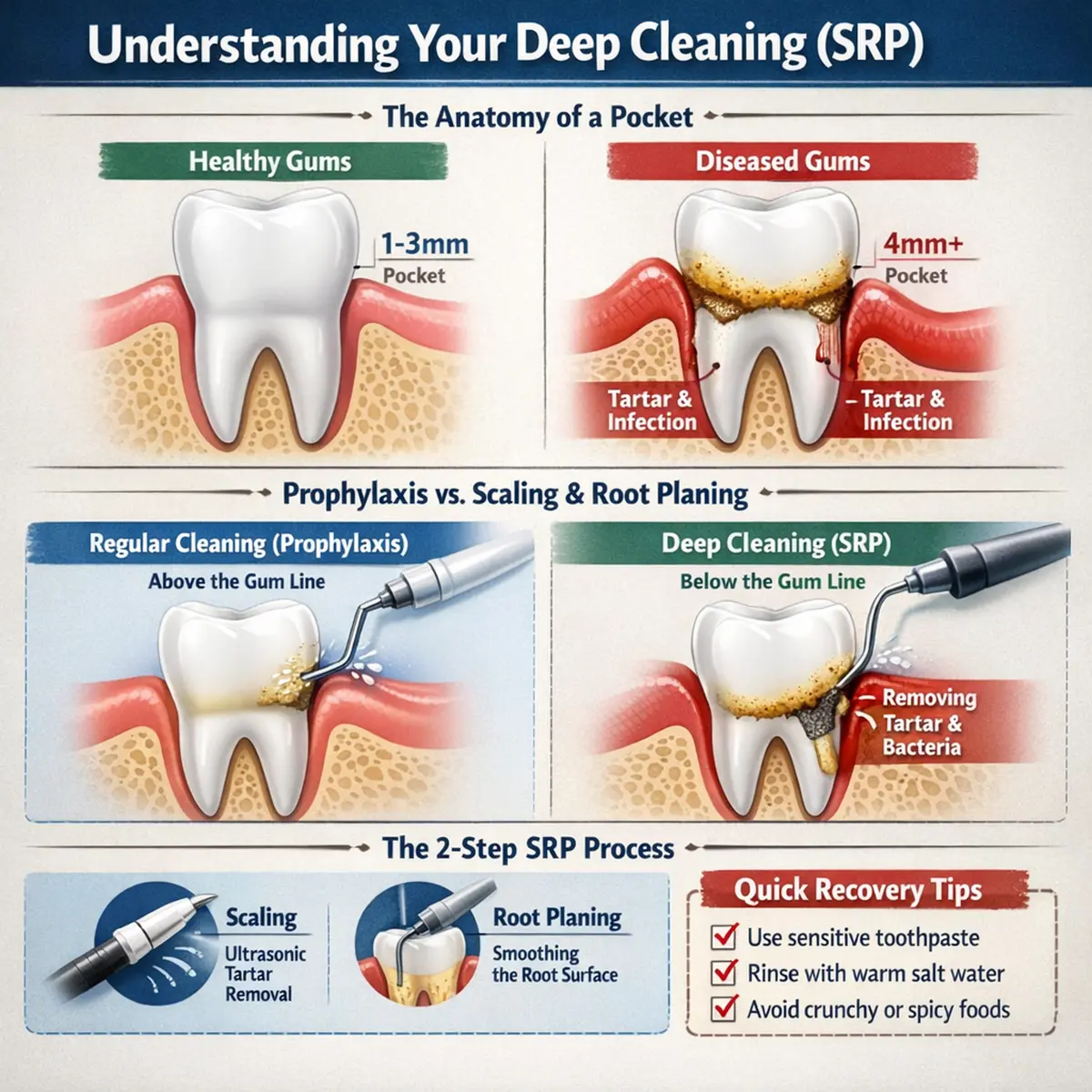
Understanding Your Deep Cleaning
| Feature | Regular Cleaning | Deep Cleaning (Scaling & Root Planing) |
|---|---|---|
| Target Area | Above the gum line | Below the gum line and root surfaces |
| Purpose | Routine prevention | Treat active gum infection |
| Plaque & Tartar Removal | Light to moderate buildup | Heavy tartar and bacterial deposits |
| Gum Pocket Depth | 1–3 mm | 4 mm or deeper |
| Anesthesia Required | Rarely needed | Typically required for comfort |
| Treatment Sessions | Single visit | 2–4 visits (quadrant-based) |
| Who Needs It | Patients with healthy gums | Patients with periodontal disease |
| Outcome | Maintains oral health | Helps gums heal and reattach to teeth |
Insurance Coverage & Procedure Codes
When reviewing your treatment plan, you may see specific dental codes. D4341 refers to scaling and root planing for four or more teeth in a single quadrant, while D4342 is used for smaller areas of one to three teeth. Most insurance providers cover these 'deep cleanings' at a higher percentage than surgical gum therapy, making it a cost-effective way to prevent future tooth loss.
Expert Insight
According to Dr. Pooja Joshi, Early intervention through deep cleaning can halt the progression of gum disease and reduce the risk of tooth loss.
Frequently Asked Questions
What is a deep cleaning and how is it different from a regular dental cleaning?
A deep cleaning, also called scaling and root planing, cleans below the gum line to remove bacteria and tartar that cause gum disease, while a regular cleaning only treats the visible surfaces of the teeth.
How long does a scaling and root planing procedure take?
Deep cleaning is usually done in two to four visits, with each appointment lasting about 45 to 60 minutes, depending on the severity of gum disease.
Will my teeth or gums hurt after a deep cleaning?
Mild soreness and sensitivity are common for a few days after treatment, but discomfort is usually manageable with proper aftercare and improves as the gums heal.
How long do the results of a deep cleaning last?
With good oral hygiene and regular dental visits, the benefits of scaling and root planing can last for years and help prevent gum disease from returning.
Conclusion
References
Last Reviewed: All references below were reviewed for clinical accuracy and relevance by Dr. Reshma J. Nilak on February 14, 2026.
- References 1. American Dental Association (ADA). Periodontal (Gum) Disease Overview. https://www.ada.org/resources/ada-library/oral-health-topics/gum-disease 2. Centers for Disease Control and Prevention (CDC). About Periodontal (Gum) Disease. https://www.cdc.gov/oral-health/about/gum-periodontal-disease.html 3. Al-Rihaymee S, Mahmood MS, Abdulbaqi HR, et al. Platelet-rich fibrin as an adjunct to scaling and root planing in shallow periodontal pockets: A randomized clinical trial. *Journal of Oral Biosciences*. 2024. https://pubmed.ncbi.nlm.nih.gov/38997108/ 4. Arnett MC, Chanthavisouk P, Costalonga M, et al. Effect of scaling and root planing with and without adjunctive therapy on periodontal outcomes. *Journal of Periodontology*. 2023. https://pubmed.ncbi.nlm.nih.gov/37191955/
The information provided on this website is for general informational purposes only and should not be considered as professional medical or dental advice. Always consult with a qualified dentist or healthcare provider for diagnosis and treatment of any dental condition.
⚠️ Important: Never disregard professional medical advice or delay seeking treatment because of information you have read on this site.
Last reviewed: February 2026 by our dental experts.
Watch Video
Related Articles